
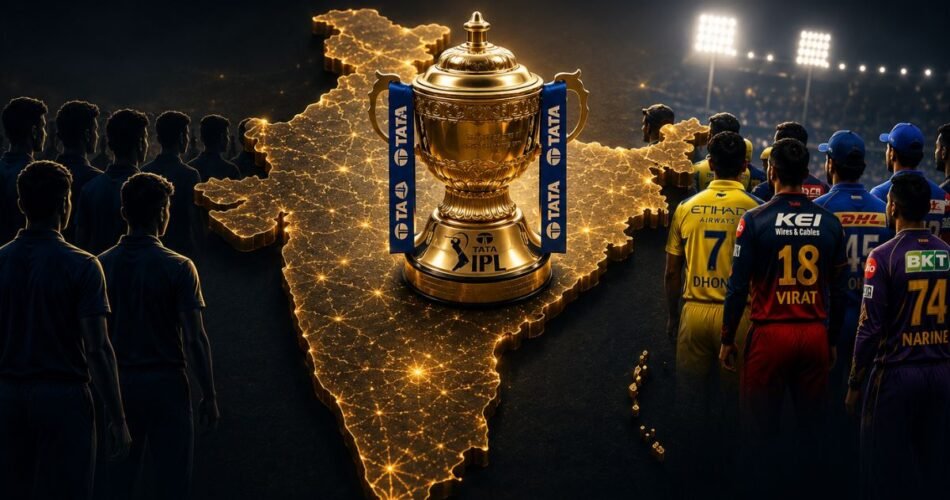
Vaibhav Suryavanshi made headlines when he stepped out to bat for Rajasthan Royals in the IPL, representing a small town in Bihar. It seemed to be a symbol of talent meeting opportunity, as the league’s tagline suggests. However, when you look beyond the individual success stories, a different narrative emerges.
State-wise, the distribution of players in the IPL is uneven. Punjab, Delhi, Maharashtra, and Mumbai have a significant number of players in the league, while states like Tripura and the North East have zero representation. Despite the presence of talent across the country, the opportunities for players from certain regions are limited.
The disparity in IPL representation mirrors historical patterns of power distribution in India, with a concentration of opportunities in certain regions while others remain underserved. There is a need to address this imbalance and provide equal opportunities for all talented players across the country. The traditional pathways of infrastructure, connectivity, and institutional investment continue to shape the landscape as they always have.
Graphic 02 of IPL 2026 showcases the state-wise representation in the tournament, ranking all 26 state/association groupings based on player count. The data reveals high, mid, low, and zero representation for each state/association. For example, Tripura has zero representation despite being affiliated with BCCI since 1985, while the North East region collectively has around 1-2 players in the IPL.
Punjab stands out with 17 players spread across six different franchises, leveraging its international airports, cricket infrastructure, and T20 league to nurture talent for the IPL. Similarly, Madhya Pradesh, Delhi, and Uttar Pradesh have 13, 13, and 11 players respectively, showcasing their contributions to the league. The states in the Hindi heartland are making significant investments in cricket and are now prominently represented in IPL dugouts.
M.B. Mura Singh, a seasoned cricketer from Tripura, highlighted the lack of infrastructure in his state during a conversation with Financial Express.com. Despite being affiliated since 1985, Tripura has never hosted an international match due to the absence of an international ground. The construction of an international stadium is underway but has not yet been completed, illustrating the state’s lag in infrastructure development. Singh, however, expressed this fact without any bitterness or complaint. He is explaining a cyclical pattern where structural challenges continue to accumulate with each passing season.
When a country hosts an international match, the hosting association receives a portion of the ticket sales and the BCCI’s match funds. This financial support is then reinvested into improving grounds, training academies, coaching facilities, and state T20 leagues. These leagues provide players with exposure through live broadcasts before the IPL auctions. However, in regions like Tripura, where international matches are not held, there is a lack of revenue generation. This leads to fewer T20 leagues, which in turn reduces visibility for players. As a result, scouts are less likely to visit such areas. Mura Singh highlighted this issue by pointing out that scouts would have to take a flight to reach Tripura, further complicating the scouting process. This creates a continuous loop of limited opportunities for players in regions facing structural challenges. Breaking from the inside is a challenging task. The content of the text is about the structural loop in cricket that widens the gap between established and peripheral states with each auction cycle. The argument presented is that while the BCCI distributes equal revenue to all state associations, the outcomes vary based on how states invest in grassroots programs and player development. The text highlights the importance of time as a limited resource in cricket and the impact of deliberate state-level investments in infrastructure. The IPL auction is described as a visibility contest where franchises buy what they have seen, leading to disparities in representation based on broadcast leagues and player exposure. The voices of former players and administrators emphasize the importance of state-level development and institutional support in shaping team compositions and player opportunities in the IPL. He wants to avoid discussing entitlement in the conversation.
“Talent is recognized and rewarded regardless of location. It may take time for a talented player from a smaller state to gain recognition, as seen with Riyan Parag, who has excelled after being picked for the IPL. We now have a captain from Assam,” he explained.
The delay in visibility for talented individuals from structurally disadvantaged states is evident in the data. The issue lies not in the lack of talent but in the uneven distribution of systems that convert talent into opportunities. The IPL operates within these systems rather than challenging them.
Parvez Rasool’s career exemplifies this point. Despite his success, he was essentially alone in his journey. The infrastructure needed to produce more players like him from J&K is only now being developed.
The Suryavanshi case highlights the exceptional nature of talent from Bihar. While Bihar has three players in the IPL, it is not proportionate to its population. The brilliance of individual players does not fix the systemic issues but rather emphasizes the disparities in the system.
Structural changes are needed to address these disparities, such as hosting more international matches in different cities, broadcasting state T20 leagues, and providing additional support to associations with inadequate infrastructure. These changes are crucial for closing the gap in opportunities for players from various states.
The focus should not solely be on individual players like Sakibul Gani, who has excelled in domestic cricket despite the lack of facilities back home. Players like him just want to play and showcase their talent, rather than being burdened with fixing systemic issues.
While the BCCI’s tagline “Where talent meets opportunity” has some truth to it, the data from IPL 2026 suggests that the meeting of talent and opportunity still primarily occurs within existing structures. The content needs to be rewritten in order to improve clarity and coherence.
Follow Franchise Cricket for more IPL news.

